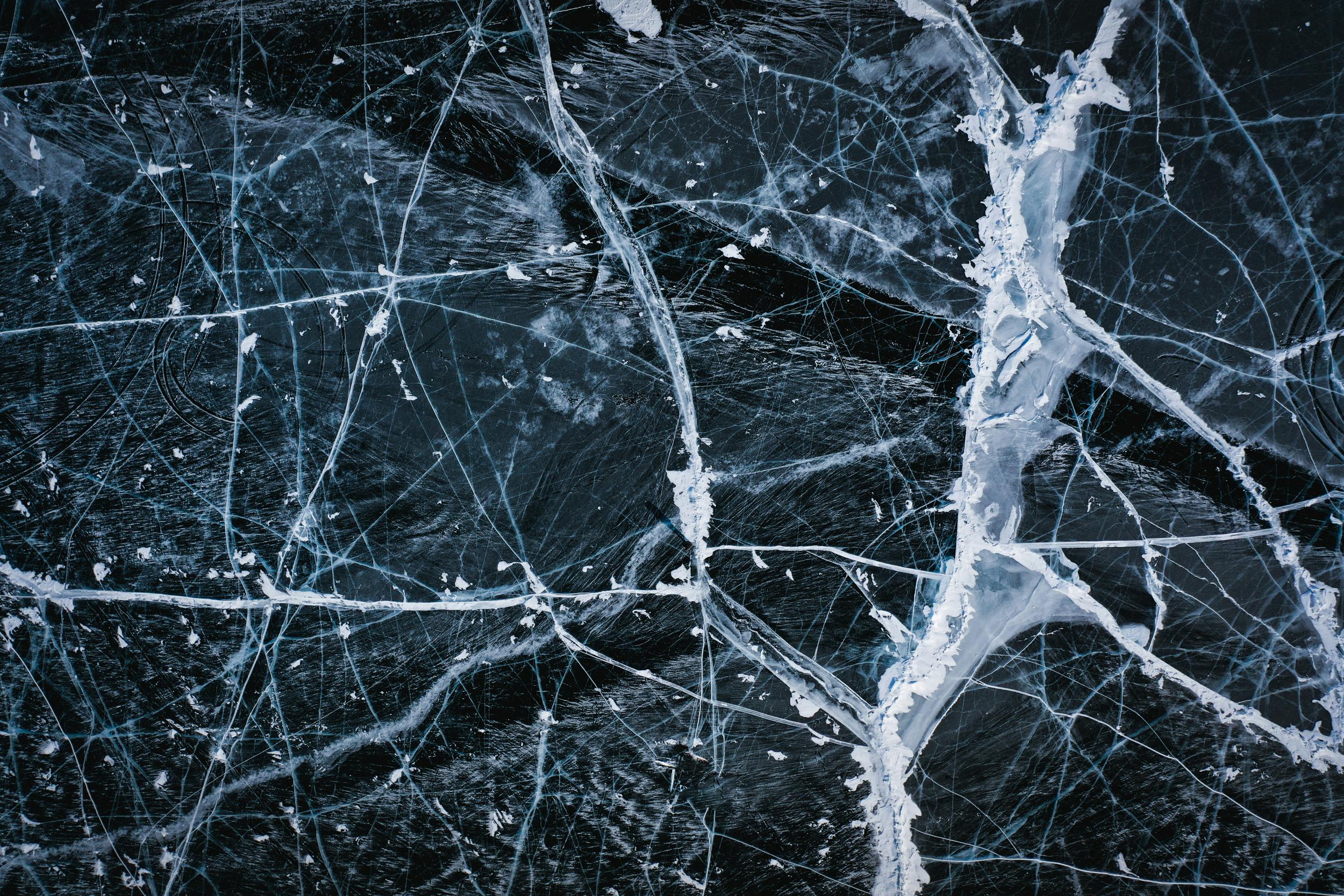
(image credit: by Maksim Romashkin)
Melting ice might seem simple—but beneath the surface lies a fascinating tale of energy, structure, and molecular freedom. Learn how ice transforms, molecule by molecule, from solid to liquid.
What Really Happens When Ice Melts?
At a glance, watching ice melt seems like the most ordinary thing. Toss a cube into your drink, and a few minutes later, it disappears into liquid. But what’s going on at the microscopic level is pure science magic—and it all begins with the structure of water molecules.
Ice: A Solid with a Special Structure
Ice is the solid phase of water (H₂O). In its solid form, water molecules are locked into a rigid, hexagonal crystalline structure, where each molecule is held in place by hydrogen bonds—a type of weak chemical attraction between the slightly positive hydrogen atoms and the slightly negative oxygen atoms of nearby molecules.
This structure is not only stable but also unique. It actually makes ice less dense than liquid water, which is why ice floats—an anomaly among solids and a feature critical to life on Earth (think: lakes freezing from the top down, not bottom up).
The Phase Transition: From Solid to Liquid
So what happens when ice melts?
As the surrounding temperature rises above 0°C (32°F), the heat energy begins to enter the ice. But instead of instantly increasing the temperature of the water, this energy is first used to break the hydrogen bonds between the molecules. This energy is known as the latent heat of fusion—and it’s what allows ice to absorb a significant amount of heat without actually changing temperature while it’s melting.
During this process:
Molecules begin vibrating more vigorously.
The crystal lattice starts to collapse.
The rigid structure gives way to a looser arrangement, allowing the molecules to move more freely.
Once all the hydrogen bonds holding the structure are broken, the ice becomes liquid water.
Why Ice Feels So Cooling
Here’s something cool—literally. When ice melts in your drink or on your skin, it draws in heat from its surroundings to fuel the melting process. This is endothermic, meaning it absorbs energy. That’s why ice feels cold—it’s stealing heat from your hand or your beverage to change state.
This principle is widely used in cooling systems and ice packs, which rely on this heat absorption to relieve inflammation or keep items cold without direct refrigeration.